SearchLens: composing and capturing complex user interests for exploratory search

Joseph Chee Chang·Nathan Hahn·Adam Perer
IUI·2019·65 citations

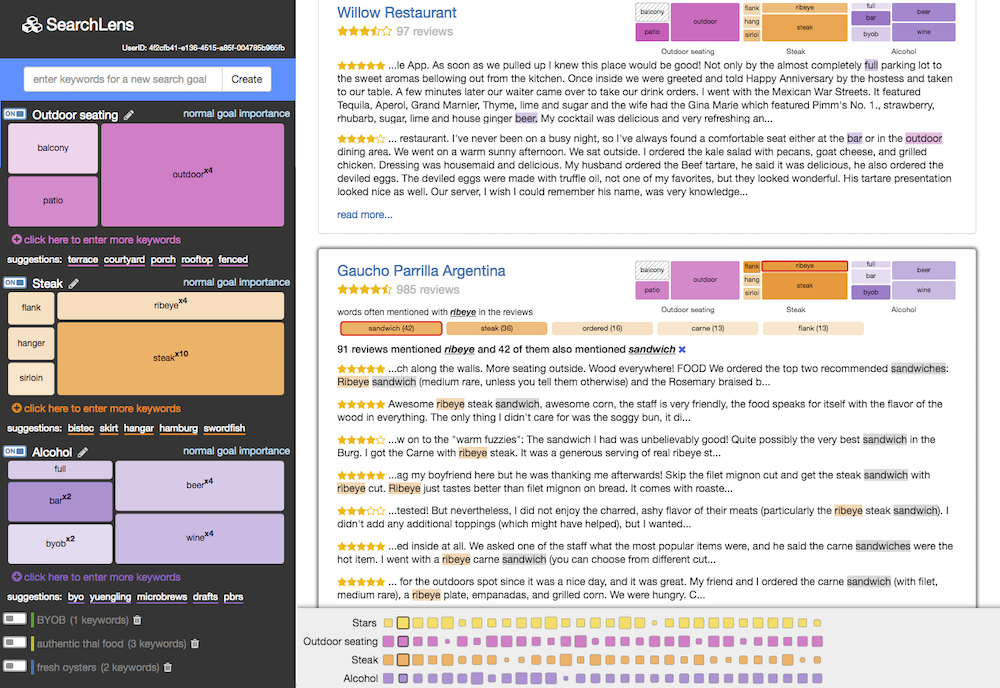
TLDRResults from a controlled lab study suggest that the approach incentivized participants to express their interests more richly than in a baseline condition, and a field study showed that participants found benefits in SearchLens while conducting their own tasks.
SearchLens: Composing and Capturing Complex User Interests for Exploratory Search

How do people cite this paper?

(generated 20 days ago)

SearchLens has influenced subsequent research by introducing the composable "lens" metaphor for user-defined weighted keyword collections—directly extended into polymorphic lenses over knowledge graphs—while also serving as a reference design for augmenting faceted search with user-specified criteria, informing visual explanation techniques such as color-encoded keyword-result associations and space-filling relevance representations in exploratory search interfaces, motivating tools for structuring and synthesizing information during complex sensemaking tasks, and prompting investigation into the adequacy of cosine similarity for subjective tag matching in search systems.

Talks and Demo Videos

Video Figure

Loading PDF reader...

SearchLens: composing and capturing complex user interests for exploratory search

Joseph Chee Chang·Nathan Hahn·Adam Perer
IUI·2019·65 citations

TLDRResults from a controlled lab study suggest that the approach incentivized participants to express their interests more richly than in a baseline condition, and a field study showed that participants found benefits in SearchLens while conducting their own tasks.

SearchLens: Composing and Capturing Complex User Interests for Exploratory Search

How do people cite this paper?

(generated 20 days ago)

SearchLens has influenced subsequent research by introducing the composable "lens" metaphor for user-defined weighted keyword collections—directly extended into polymorphic lenses over knowledge graphs—while also serving as a reference design for augmenting faceted search with user-specified criteria, informing visual explanation techniques such as color-encoded keyword-result associations and space-filling relevance representations in exploratory search interfaces, motivating tools for structuring and synthesizing information during complex sensemaking tasks, and prompting investigation into the adequacy of cosine similarity for subjective tag matching in search systems.

Talks and Demo Videos

Video Figure

Paper

Loading PDF reader...