Tabs.do: Task-Centric Browser Tab Management
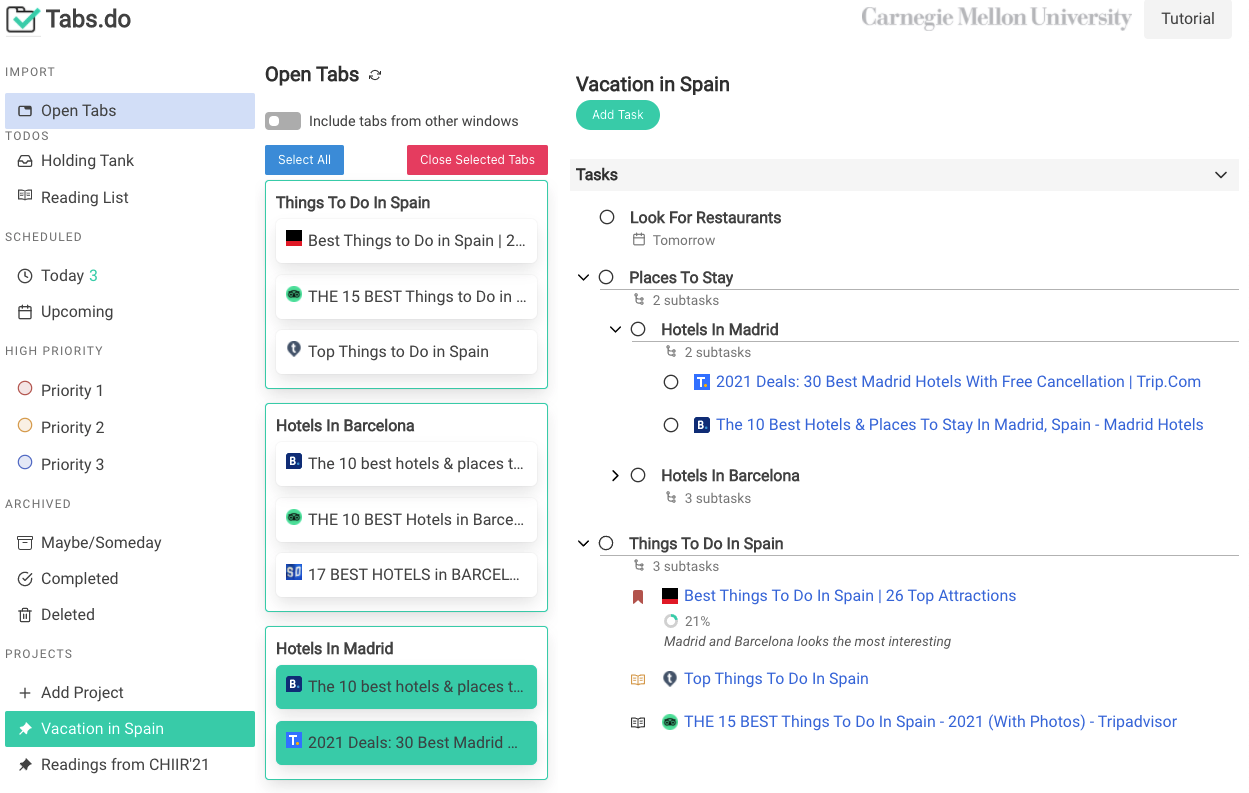
TLDRA Chrome extension called Tabs.do is introduced, which explores bringing a task-centric approach to the browser, helping users to group their tabs into tasks and then organize, prioritize, and switch between those tasks fluidly.
How do people cite this paper?
(generated 7 months ago)Tabs.do has informed subsequent research in several ways: its characterization of tab overload and the mismatch between browser interfaces and users' task mental models has been used to motivate new approaches to managing browsing complexity and web-based sensemaking tools; its ML-based tab grouping method has served as a comparative baseline for privacy-preserving task inference techniques; its task-centric design strategies—such as lightweight interactions for organizing information and context-aware suggestions—have influenced the design of systems for collecting and triaging web content, scrap management tools, and multi-page web exploration interfaces; and its field deployment methodology and observations about evolving browsing patterns have been referenced in work studying large-scale web usage behavior.
Mentions
- Mashable: Stop trying to work in multiple browser tabs. It's terrible for your focus. Tab hoarding gives the illusion that multitasking is possible, but it's not. — Rebecca Ruiz
- Fast Company: The twisted psychology of browser tabs—and why we can't get rid of them. New research proves that it's not just you: Browser tabs are scientifically terrible. — Mark Wilson
- Metro New UK: Suffer from 'tab overload'? Scientists study why we have so many open. — Katherine Hignett
- CMU News: Overcoming Tab Overload. CMU researchers develop tool to better manage browser tabs. — Aaron Aupperlee
- GeekWire: AI, the brain, and the crowd: Research explores new ways for humans and tech to work together — Todd Bishop
Talks and Demo Videos
30 Seconds Preview (UIST 2021)
Presentation (UIST 2021)