Alloy: Clustering with Crowds and Computation

Joseph Chee Chang·A. Kittur·Nathan Hahn
CHI·2016·54 citations🏆 Best Paper Honorable Mention

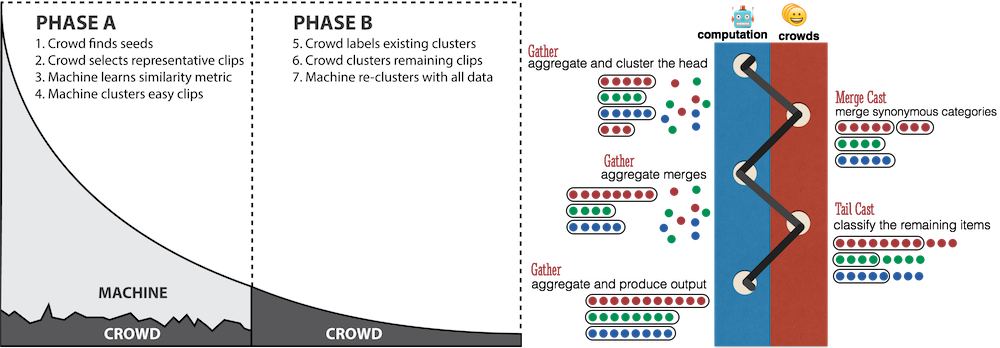
TLDRAlloy, a hybrid approach that combines the richness of human judgments with the power of machine algorithms, is introduced, a modular "cast and gather" approach which leverages a machine learning backbone to stitch together different types of judgment tasks.
Alloy: Clustering with Crowds and Computation

How do people cite this paper?

(generated 20 days ago)

Alloy's human-machine hybrid workflow for clustering text — combining crowd judgments with machine learning to handle global context and edge cases — has informed the design of numerous interactive systems that blend crowdsourcing with computation for knowledge synthesis and taxonomy creation, served as a reference approach for leveraging user feedback in interactive machine learning, motivated techniques that use sample-and-search strategies to help novice crowdworkers categorize textual datasets, contributed observations about crowd behavior (e.g., that workers focus on large groups first and lack global dataset understanding) that shape task design in crowd-powered systems, and provided a model for dividing responsibilities between humans and machines that has been extended across domains including document organization, distributed sensemaking, data cleaning, and active label collection and concept discovery.

Loading PDF reader...

Alloy: Clustering with Crowds and Computation

Joseph Chee Chang·A. Kittur·Nathan Hahn
CHI·2016·54 citations🏆 Best Paper Honorable Mention

TLDRAlloy, a hybrid approach that combines the richness of human judgments with the power of machine algorithms, is introduced, a modular "cast and gather" approach which leverages a machine learning backbone to stitch together different types of judgment tasks.

Alloy: Clustering with Crowds and Computation

How do people cite this paper?

(generated 20 days ago)

Alloy's human-machine hybrid workflow for clustering text — combining crowd judgments with machine learning to handle global context and edge cases — has informed the design of numerous interactive systems that blend crowdsourcing with computation for knowledge synthesis and taxonomy creation, served as a reference approach for leveraging user feedback in interactive machine learning, motivated techniques that use sample-and-search strategies to help novice crowdworkers categorize textual datasets, contributed observations about crowd behavior (e.g., that workers focus on large groups first and lack global dataset understanding) that shape task design in crowd-powered systems, and provided a model for dividing responsibilities between humans and machines that has been extended across domains including document organization, distributed sensemaking, data cleaning, and active label collection and concept discovery.

Paper

Loading PDF reader...